
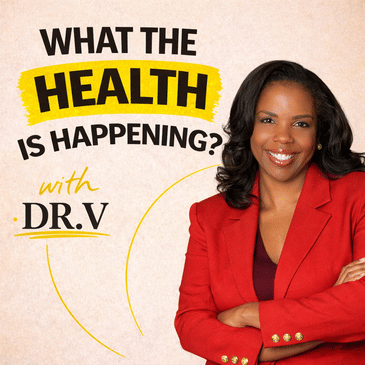
Ever wonder why healthcare is so costly and if there is anything that you can do about it? Get the inside scoop about healthcare costs, and direct answers to listener questions from Dr. V, a 30-year emergency room doc.
In this episode you'll learn more about the business of health and how you can get financial assistance when you need it. Plus, enjoy a little laughter for your pain with Comedian Damon Williams.
Hey there, I'm your host, Dr. Valda Crowder, and welcome to my new show. I'm a board certified emergency medicine physician and I've been working on the forefront of healthcare now for more than 20 years. I've practiced through four pandemics, one mass shooting, and a category four hurricane. Many of you I have interfaced with during the COVID-19 pandemic, where I was on various radio shows helping guide people through the pandemic. That time I took my expertise to the airways to help thousands of families navigate through the healthcare emergency that we all went through. Today I'm launching my own show so I can meet you at the point of needs, positioning and empowering you to be informed healthcare advocates for yourself and those you love. One of the biggest questions I get is about the high cost of healthcare. So I'm starting off answering your most pressing questions about the healthcare system and why it is so expensive. This will be a two-part series. If you would prefer to actually send a question in, you can send a question in at info at askdrv.us. Info at askdrv.us. Did your business believe in the empowerment of the community? Do you want to be part of advancing their understanding of health and overall well-being? Ready to reach more people while growing your brand and visibility with your audience? Maybe you want to help eliminate racial medical disparities. Advertise on the show. 30 seconds and one-minute spots are available. Email our team at infowasdrb.us. That's info ataskdrv.us. And find out how you can advertise. We'd love to see how we can work together to reach and empower our audience. All right, as an award-winning physician for over 20 years, I've seen my fair share of life-altering health emergencies. But too many families bear the burden of navigating the healthcare system, which takes away from their time and energy and ability to focus solely on healing. I am so excited you are joining me, and I want to begin our first show by taking a deep dive into the business of healthcare. So, our topic today, why is healthcare so expensive? First of all, is it expensive? The U.S. healthcare system is the most expensive healthcare system in the world compared to any other developed country. So we kind of measure that by how much a country actually spends on its health care per person. In 2023, the United States spent$12,742 per person. In Italy, they only spend$4,032 per person. Now here's the question. You know, are we getting more for this additional money? Actually, we're getting less. The U.S. has a life expectancy of 77, and Italy has a life expectancy of 82 years. All right, so Italy spends a third of what we spend, yet they live five additional years. So why is it that we are spending more money on our healthcare system and getting less? So I want to go over a couple of the reasons. So one is our healthcare system has a lot of burdensome administrative costs. They are administrative overhead costs that include intricate paperwork for claims, every insurance company having different types of forms, pre-authorizations, denials, challenges, resubmissions. Overall, 30% of our health care expenditures go towards administrative tasks. In other countries, they keep their administrative costs less than 5%. Now let's talk about drug prices. Pharmaceutical drug prices in the United States are also higher. You may have noticed if you vacationed to another country that you actually saw pharmacies that you could walk in and get medications without a prescription. There's a wide variety of medications you can get in other countries without a prescription, and these medications are often cheaper. This is because in the US there is minimal government regulation in pharmaceutical on pharmaceutical companies, and they have more latitude to set their own prices. In other countries, there is more government regulation that actually requires the pharmaceutical companies to make these medications available and available at a lower cost. So traditionally, Medicare has been unable to negotiate prescription drug prices for seniors and for disabled people. For the first time in history, thanks to the Inflation Reduction Act in 2022, which was signed by President Biden and Vice President Harris, was the tiebreaking vote in the Senate, Medicare is now able to negotiate drug prices for seniors and people with disability. This is expected to save billions. So people in Medicare will save about$1.5 billion in prescription cost alone in 2026, and this will have recurring benefits over time. When the negotiated price effects go into effect in 2026, people enrolled in Medicare prescription drug coverage will save under the projected defined standard benefit. This will be for 10 drugs and part of your Medicare Part D. The 10 drugs affected will be Novolog, which is a form of insulin for diabetes, Farsega, Embrel, Jardins, Stellara, Zorelto, Eloquis, Entresto, and Ambruvica, which is used for blood cancers. All of these changes will occur in 2026. Another cost that leads to high health care expenditures is the practice of defensive medicine. And basically, this is when physicians order tests or procedures for the sole reason of protecting against potential lawsuits rather than actually benefit benefiting the patient. And this actually becomes over time a part of standard medical practice. And this happens in the U.S. because we have very few legal protections for physicians in hospitals compared to other countries. The over-testing, the over-prescribing, the over-referral to specialists, avoiding high-risk procedures and treatments all increase the cost of health care. But over time, these practices become standard medical care. Couple that with the fact that we have a fee-for-service model where you get more payment based upon the volume of services provided. There's an actual incentive to actually practice defensive medicine. All right, the fourth reason you have no price transparency. You do not know how much anything costs in the hospital or the doctor's office. Hospitals and healthcare practices can change different rates for the same services based upon location, insurance status, and even the hospital's financial goals. Patients often don't know the cost of anything, any procedure or any treatment until it is over and they've been provided a bill weeks later. This makes it impossible for patients to actually price compare and for the market to really be competitive. The fifth reason for high cost of health care in the United States is our high rate of chronic disease. So in the U.S., we have a higher rate than Europe of obesity, diabetes, and cardiovascular disease. Lifestyle plus the food that we allow into our food system are all things that are associated with our high rate of chronic disease. Now, I often get asked about this: the high wages for doctors and nurses. U.S. doctors, nurses, and specialists are often amongst the highest paid in the world. But their wages are higher for several reasons. One is they have much, much more rigorous training and longer education requirements. So U.S. physicians can practice almost anywhere, where physicians that have practiced in other countries often do not meet our standards to practice in the United States. You also have high wages because of the low supply of nurses and doctors. And so that drives up wages because we are not graduating enough physicians, nurse practitioners, nurses, and LPNs. Lastly, you have a lot of student loan indebtedness. The average medical student comes out of medical school with$206,924 in student loan indebtedness according to the Association of American Medical Colleges. However, if all of the physicians tomorrow decided to actually work for free and work for free ongoingly, it would save our healthcare system about 5%. So let's go on to some of the other reasons. One, seven is uh advanced medical technology. U.S. is great for high-tech medicine. We have all the gadgets and gizmos. In fact, many people traveled to the United States to get the latest advances in technology and imaging. This includes robotic tools, innovative cancer treatments, etc. We have easy access to the latest and greatest technology. However, these medical advances are often expensive and also contribute to the high cost of health care. Number eight, we have a fragmented healthcare system. Often one hospital or doctor's office can find it difficult to share information with another hospital or doctor's office. They will have health care or electronic health records that don't interface and communicate with each other. This lack of integration makes it harder to provide quality care and also can lead to duplicative tests andor treatment. Better integration would allow us to better manage patients and provide a clear, coordinated, and concise centralized treatment plan as well as provide cost savings. Nine, of folks that are uninsured. So in the US, we have about 8% of our population that is uninsured. If you compare that to Germany, they only have 0.1% of their country that is uninsured. In Canada, UK, and Italy, 0% are uninsured. So in the United States, 8% of our population being uninsured is about 26 million people. It used to be 46, 47 million people, but 20 million people were able to get insurance through Obamacare. In addition to the 26 million that we currently have that are uninsured, we have 50 million people that are underinsured. So here's what underinsured means. It means that you've had gaps in your insurance, either because of a job change, waiting for your insurance to become effective, or you have out-of-pocket expenses that are more than 10% of your household income, or you have deductibles that are more than 5% of your yearly income. So how do people who are uninsured or underinsured drive up the cost of health care? Well, often what happens is, again, because they don't want to incur these expenses, they don't go to the doctor until they're very, very sick. They may skip tests or treatments, they may not fill a prescription, they may skip a medication dosing or split a medication dosing. They also may skip seeing a specialist. And then what happens is whatever their underlying disease is, it progresses and it is more likely to present at a later stage when the treatment is even more expensive. So it's important to know that in the emergency department, you get treated no matter what your insurance status is. It is important for you to know your rights. Never actually avoid going to the emergency department because of insurance-related issues. A law was passed back in 1986 called EMTLA. It's the Emergency Medical Medical Treatment and Labor Act. It was passed by Ronald Reagan to stop patient dumping. So all hospital EDs receiving Medicare funding, which is essentially almost all U.S. hospitals, must provide a medical screening exam by a qualified provider to check for an emergency condition. They must treat the emergency condition until it's stabilized or transfer you if needed. All right, so when we return, I'm going to answer your questions about the cost of health care. All right, it's time for some QA. So if you have some questions and topics you want to discuss, please email me at info at askdrv.us. All right, we've got our first question from Linda from DC.
SPEAKER_02Hey, Dr. V. This is Linda calling from DC. Thanks for taking my call. During the pandemic, everyone in my family, I mean everyone, was a big fan of your webinars on COVID-19. We shared your tips and your advice widely with everyone we knew. They save lives, your advice. That's why I'm excited about what you're doing now. I have two questions. My mother, my aunt, and a friend have severe allergies. They should always carry in an EpiPen. One person who shall remain nameless has expired epipins. If necessary, they plan to use them. They really must buy new ones, but they are very expensive. Um my understanding is they cost about$150 for one. But epinephrine is a drug that's been around for a long time. Shouldn't there be a cheaper generic by now? My second question. I have a family member, not one of the three I was just talking about, um, that was admitted to the hospital and they received a surprise bill from a company of one of the doctors that was not the hospital. How does this happen? Uh we thought all the doctors we saw were part of the hospital. Thank you in advance.
SPEAKER_04All right, Linda, thanks for that question. So, EpiPens, this is very interesting. So, in general, a pharmaceutical company will apply for a patent and the patent will last for 20 years. So the medication in an EpiPen, which is epinephrine, has been off patent for a very, very long time. What is not off-patent or hasn't been until recently is the actual auto injector. So the company that makes epipens is a company by the name of Myelin. So Myelin secured the patent for the actual auto injector. And then when the patent was about to expire every 20 years, they would make a small improvement to the auto injector so that they would get another 20 years. So this actually led to them having essentially a monopoly for many, many years. We are now just seeing where auto injectors are actually being made by other companies and other companies are entering into the marketplace. But EpiPens stayed expensive for so long because of the auto injector, not because of the actual medication that's in the auto injector. So thanks for that. Thanks for that question. All right, and then your other question was about your family member that went to the doctor and received a bill from someone from a company that was not the hospital. So a lot of hospitals actually outsource the staffing of their hospital. They can outsource their emergency medicine physicians, they can outsource their anesthesiologists, and even when you're in the hospital, you will interface with those providers and they will have a badge that makes it look like they are from the hospital, but they are actually subcontracted out. So when you are discharged from the hospital, you'll have your hospital bill, and then you will also have a bill from these subcontractors. Many times these subcontractors are out of network and people would receive a surprise bill because they were out of network. There was legislation passed called no surprise medical bills, so that now these out-of-network subcontractors cannot charge you more than you would ordinarily get charged if you were in network. So that is how come you actually get a bill from the hospital, and sometimes you also get a bill from a different company. And if you want to be sure that you've got a bill from the correct company, you can always call the hospital and say, you know, did you subcontract with this particular uh company? Is this bill associated with my hospital stay? So you make sure that the bill that you're receiving is not in some way, shape, or form fraudulent. All right. Well, speaking of EpiPens and how expensive they are, I have another question, and it is from uh Kim. She emailed in this question. And her question is the new weight loss drugs are all so expensive. So why are these drugs so expensive? They cost roughly about$1,000 a month, and you have to be on them for several months. Okay, well let's let's talk about this. The the medications and the weight loss medications that she's talking about are GLP1s, also called glucagon-like peptide one receptors, agonists, and they mimic your natural GLP1 hormone. This medication controls insulin and blood glucose, and it also makes you feel very full. What's important is several other manufacturers have applications in to get them approved by the FDA. Um and yes, they are about$1,000 a month. Um now I really recommend that people really go to a physician, whether or not you go to your primary care physician or you use a telehealth physician, and make sure you get all of the proper testing that you need and all the proper monitoring while using these medications and make sure you're using it for the correct use. As far as the expense, it's very much like EpiPen. You're paying for not only the medication, but you're paying for the auto injector. So anytime you have a medication that comes out as a single dose and it is a dose that they're giving you a device for where you auto-inject yourself, you're paying for the medication plus the auto injection. Now, what's happening is um Eli Lilly is actually looking at selling this in a syringe, similar to the way you actually sell insulin. So people who are diabetic know that they don't get an auto injector for their diabetes, they get a they get a bottle, a vial with the medication in it, and then they draw up the amount of medication that they need, and then they self-inject with a regular old syringe needle. So Eli Lilly is looking at actually uh selling it this way, which would cut the price about in half. If you want to get information about that, you need to go to lilydirect.com. Also, with any new medication, whether or not it's this medication or any other medication, there are almost always coupons. So any medication that you is new and you're spending a lot of money on it, Google the name of the medication and coupons, and you will often see uh coupons that are given out by the pharmaceutical company online that you print out and then you bring to the pharmacy. You can also use Good Rx, and if the medication is generic, you can also obviously get it in a generic format. But when the medication is new, you really have to depend upon manufacturer coupons. All right, we've got a uh question uh from uh Marie in uh New Haven, Connecticut. She wants to know why do healthcare expenses get so high for seniors, especially when you've worked hard all your life? It's not fair. Um, she says that um she was actually dropped from her job's insurance after 70, and the supplemental insurance is not enough to cover the expenses. Um, and seniors are having a hard time having to pay out of pocket uh once they've actually retired and they actually have less money. Okay, so let me uh explain this. Uh Medicare is often not as good as the health care insurance that you get through your employer. And I want to explain the different parts and how it actually works. So as long as you have paid Medicare taxes for 10 years, you get various parts of Medicare, which are Part A, Part B, Part C, and Part D. Part A is your hospitalization. It covers hospitalizations that are at least two midnights, and there is a no premium associated with Medicare Part A. What there is associated with Medicare Part A is a deductible of$1,632 a year. So if you're hospitalized that portion of the bill, you have to pay. The other thing is that the hospitalization component of Medicare is only good for the first 60 days that you're hospitalized. On the 61st day, then you become responsible for$408 a day. Starting at 91 days, you actually become responsible for even more of the bill. So if you have a lengthy hospitalization, we had a lot of people who had a lengthy hospitalization, like let's say during COVID, who might have been in the hospital for two or three months, it can really become very expensive fast. Now, Part B is a part of Medicare for doctor's visits, outpatient equipment, etc. That has a premium that's roughly about$175 a month. If your income is higher, then the premium can be higher. So they look at your income from the last couple of years, and based upon your income, your premium could be more. The maximum premium that they will charge you is$560.50. That also has a deductible of$240. And once you pay the deductible, then Medicare only covers 80% of the bill. So that's why a lot of people get Medigap insurance. You'll hear them talk about Medigap insurance, which is another$150,$300. So, you know, when you look at all of this, you know, Medicare is not really as good as what you have when you actually are working and when you're actually employed. A lot of people have 90% or maybe even 100% coverage when they are employed. Now, one thing that you can do if the Medicare, medical costs are getting too expensive, is some people switch over to Part C, which is Medicare Advantage. So what that does is that doesn't have any premium associated with it. But what it does is it keeps you in a particular network, or you have to get approvals to see a specialist, has a little bit more constraints on your ability to access things. And so some people actually do that as a way of actually containing their cost a little bit more. And finally, there is Part D, and Part D is for prescriptions. And that premium also varies, but it's roughly about$55,000,$60 a month. It has a deductible of$545. Um, and you must spend that at the very beginning. Once you actually, once the plan has paid out$5,000 in pharmaceutical costs, then you have to pay 25%. So again, there's there's a lot of costs associated with Medicare that are that are not really covered, and it can be very expensive. I recommend that people get a really good Medigap insurance plan, look around for one, and if that is still too expensive, then really consider going to Medicare Advantage. Just be aware of the constraints that are placed on being in network and different access to different specialists. Okay, we have another question that came in from Danielle, and this came into our website. And here is Danielle's question. Uh Dr. V, I have Medicare and I was admitted to the hospital. Medicare did not pay for everything because they said that I was in observation. I was admitted in the hospital and admitted overnight. Why did Medicare say I was an outpatient when I was clearly admitted overnight? All right. So Medicare does not consider you to be an inpatient if you were just admitted for one to two days. Medicare considers you to be an inpatient if you were admitted for three days or more. Many hospitals have what they call uh ED observation or an observation unit, and it is a unit where you may go for further testing, maybe some further treatment, but you will be there for one night or maybe two nights. So, yes, you were admitted to the hospital overnight, but Medicare does not consider that to be an inpatient admission. Medicare considers that to be an outpatient visit, even though it was over two days. So the difference that makes is that increases your copay. You are then responsible for a larger percentage of that visit, and that is all of the tests and all the care that was provided. So I always tell people if you are on Medicare and you're going to be admitted to the hospital, please ask them and make sure, am I going to be a full inpatient admission for three days or more, or am I going to be observation? And that way you will actually know ahead of time and then you can actually make the decision from there. As I said in the previous question, Medicare requires a lot of changes and a lot of transformation to make it a little bit more user-friendly. I agree with you that you know if you're admitted, you're admitted, you spend the night, you spend the night. Most people would think I spent the night, I'm an inpatient. But that is not how the Medicare rules work. For Medicare, you have to actually spend three days in the hospital, and that is the point at which you are considered to be an inpatient, and then your reimbursements fall under inpatient Medicare reimbursement rate.
SPEAKER_01Hello, Dr. V. I wanted to touch base with you about something. During my last visit for my male wellness check, I noticed that the lab fees were substantially more. So I reached out to a good friend who works at a lab, and she provided a website that provides discounted fees for patients on the lab tests. Turns out that the lab tests were approximately$700 to$800 lower than the requisition that was going to be sent by my primary care physician. So wanted to get your ideas or opinions to determine what do you think about this practice? Is it common that we can find discounted lab fees for standard tests for a male wellness check?
SPEAKER_04All right, great question, uh, Kevin. Um so a couple things. One is your physician is going to order lab tests from wherever they're used to ordering their lab tests. Usually it is associated with the healthcare system. It's usually a lab center that is associated with their healthcare system. And they'll do that because the benefits is that it will go directly into your chart. They will see the lab results. They will call you if the lab results are abnormal, and you will be able to see the lab results on your patient portal as soon as they become available. You can find discounted places to actually get your lab tests, and you can ask your doctor, can I actually take this requisition anywhere I want to? There are a lot of places that will do lab tests for cheaper. There are a lot of online places like health labs.com, directlabs.com, community health centers, universities, medical schools. You just want to make sure that these are not lab results that your physician needs right away, and that he is okay with you going to an outside facility where maybe your results may not come back for a week. They may not come into your patient portal, he may not actually see them. So I just want to sort of make sure that if you do something like that to actually save money, that you're coordinating that with your actual physician. But yes, there are different places where you can get uh cheaper lab tests than going to wherever you're referred to by your physician.
SPEAKER_03Hey, Dr. V. Um, this is Marshay. So I had a situation where I had to get my annual breast checkup, and um it was super expensive. Like by the time they did all the tests, it was over$900, and then there were additional fees. By the time they sent me my final bill, it was in the thousands. So I'm not working right now, and when I before I even went in for my tests, I told them that, you know, the last time I got a bill, it was over$900. So I wanted to make sure that there was a way for, you know, to see if there was a program, you know, anything that I could do to waive those fees for my upcoming appointment. So I told her I was in school, and what happened was they said, Yeah, you've been approved for financial, you know, um, support since you're in school. But then after I went in for this um breast cancer test, and they said, come back to billing. And when I did, they said, Well, we can't confirm that you won't get a bill because even though you're in school, we need to know how you're paying all the rest of your bills. In other words, how am I paying, you know, my mortgage, how am I paying all my other bills, and frankly, they're I'm paying it from my savings. So I can't prove an income that's not coming in. I can't prove that that money is being used to pay my bills, and so because I wasn't able to prove the income that was coming in, they end up saying that they revoked the support that they were gonna give me or the forgiveness, the bill of forgiveness that they were gonna give me. And I know that you've mentioned that there are, you know, all these options that you might be able to have to lower your cost for payment, but it backfired on me, and um, and I feel like I was qualified to get some kind of um support. So I'm still having to pay the bill because I can't prove that I'm not working, because I'm not getting unemployment. Um, I'm in school, they saw that I was getting financial aid, but because I can't show them exactly how I'm paying for my bills, they are still charging me. I don't think that's fair. Is there any kind of reprieve um that you're aware of that I could have asked for? And by the way, this was um a secondary billing company um other than the place that I went to to get my um test done. So I don't know if it was, you know, who they used to handle their bills or what, but it was very a very stressful situation for me, and I'm sure I'm not the only person who's dealt with something like that. So any insight you can provide would be very helpful. Thank you.
SPEAKER_04All right, Mashea, thanks for that question. So um testing and imaging associated with breast exams can be very expensive, and it's very important to get it done on a yearly basis because it can really make the difference between life and death and preventing breast cancer or catching it early. So when you apply for financial assistance or charity care, which is what some hospitals call it, these programs vary dramatically. Some hospitals are more charitable than others. So Obamacare required all nonprofit hospitals to offer charity care or financial assistance in order to maintain their nonprofit tax status with the IRS. They set their own rules and each of the institutions have their own requirements, own applications, etc. For-profit hospitals can offer financial assistance and charity care, but they're not required to. So you're gonna increase your chances by doing an application with a nonprofit hospital. Now, they will ask for proof of income if you're if you're not working, they will often ask for tax returns, child support, alimony, are you getting food stamps? So they can actually figure out where are you actually getting the money to pay for your rent and other expenses. What I actually tell people, which is really, really important, is one is to apply for financial assistance to charity care if you can before you actually need the medical services. If you have an emergency and you wind up getting admitted, then as soon as you feel well enough while you're still in the hospital, ask to speak to the social worker and ask to actually complete the application and begin the process while you're actually in the hospital. If you're doing this before you actually get the medical services, do it at multiple hospitals. You may get approved at one hospital and you may not get approved at another hospital. So you may decide where to go to get the medical care based upon who actually approves you. Now, when you're paying bills with savings, they will want to see bank statements and they will want to see investments. Um if you have a high amount of savings and no income, they will expect some or part of the bill to be paid from those savings. The other thing that you can do is you can ask for a cash price. So if the bill is let's say$1,000, you can say, I will pay$600 in cash and try to get a 30 or 40% discount with a cash price. But the main thing is apply for financial assistance and charity care at multiple hospitals because each of them have different criteria and some of them are more generous than others. Good luck with that, Marcia. All right, we have a question from Missy Brown and she wants to know uh Dr. V, what are your thoughts on the impact of the Affordable Care Act or Obamacare on health care costs since it was implemented? This is a really good question. All right, so let me just go over what the Affordable Care Act, or also known as Obamacare, did. Um, it expanded coverage that you get from your insurance. So we had a lot of insurance products that only did catastrophic care or hospitalization. Obamacare required that all insurance plans that are that are being sold in the United States uh include certain things like uh preventative uh measures, prenatal visits, et cetera. Um, it also eliminated denials for pre-existing conditions, and it allows you to keep your kids on your employer health insurance plan until they turn 26 years old. The other thing that it did was it expanded Medicaid and it provided Medicaid to the working poor, people who uh made uh 133 percent or less of the federal poverty level. So that was done in subsidies that were given out to states. So 10 states have not actually passed uh Obamacare Medicaid expansion. Those states are Alabama, Florida, Georgia, Kansas, Mississippi, South Carolina, Tennessee, Texas, Wisconsin, and Wyoming. So when you actually look at what has been the impact, it is it really varied based upon whether or not you're in a state that expanded uh Medicaid under Obamacare or you did not. So in general, let me talk about the outcome. So 20 to 25 million Americans became insured that were previously unassured as a result of Obamacare. So that is significant. 25 million Americans now have insurance that didn't have insurance before. The premium costs actually did rise somewhat because all insurance now has to include a bundle of services that include preventative care. Our national health care expenditure in the United States, um, the rate of increase actually slowed down. So it didn't start to go down, but the rate of increase slowed down. The other thing that happened was uncompensated care that was covered by hospitals and and and providers, uh, the amount of uncompensated care dollars also went down. Lastly, and most importantly, in the states that expanded Medicaid under Obamacare, there was a 4% decrease in death rates for all people between 20 and 64 years old. So that's about 130,000 people that are alive as a result of Obamacare and actually getting uh insured. Death rates between 45 and 64 years old decreased by 10%. So what we found was that the states that actually expanded Medicaid actually lowered their death rate and lowered their uh uncompensated care funds. The states that did not actually expand Medicaid did not see the savings and lives that other states saw with Obamacare. Thank you for that question. That was a great question.
SPEAKER_03Does your business believe in the empowerment of the community? Do you want to be a part of advancing their understanding of health and overall well-being? Maybe you're ready to reach more people while also growing your brand and visibility. You can do that with our audience. Advertise on the each show. 30 second and one-minute spots are available. Email our team at infasdrv.us. That's info at askdrv.us and find out how you can advertise. Today we'd love to see how we can work together to reach and empower more people.
SPEAKER_04Hey Damon, so what do you think about today's topic? We've been talking about the high cost of health care. We want to hear what you think about it. Here's today's edition of Comedian Damon Williams. That's what I think.
SPEAKER_00Hey, it's comedian Damon Williams, and I think healthcare is so expensive because you got too many people involved. You got to pay, you got to co-pay, you got to see a receptionist, then the medical person with the documents, and then you got to see the nurse. The nurse has you see the doctor. By the time you see the doctor, you saw seven people. If you just cut out the middle man, let the doctor check you in, let the doctor check you out, then healthcare won't be so expensive. But no, there's no way you can get a doctor to use his precious time to do such a thing because he has to golf or he has to be out on his boat or he just don't want to do the work. Back in the day, a doctor carried a little black bag and came to the house. That's when medical expenses were cheap. That's right. House calls, let's bring that back. Then you don't need a receptionist, a nurse, uh uh, LPN, uh, UPN, a UPW. I don't know what the letters are, but you don't need all them people. That's why it costs so much. And since healthcare costs so much, that's why you see so many people walking around with stuff wrong with them. Everybody's has seen somebody with a mold they could have had removed or a limp that they shouldn't have. That's because they have to choose food over healthcare. That's right. So let's get this cost of health care down so people can get better, fix some of these peg legs and some of these moly moly faces. Now that might not be right. It might not be true, but that's what I think. It's Damon Williams, and you can catch me on Damon Williamscomedy.com.
SPEAKER_04Oh, Damon, you want to take us all the way back to house calls. Wow. There was a lot that we couldn't do during that time. But uh there are definitely a lot of middlemen and a lot of people in between the patient and the physician, which leads to additional costs. I think one thing is that we have now decided that in medicine, everyone should work at the top of their license. People often talk about work at the top of your license. The reason why they don't want the physician to um check you in and take your vitals and all that is they can pay lower priced people to do all of that and then just have the physician actually operate at the top of their license and do the things that we actually do best that require our expertise. But I agree, let's get the cost of healthcare down and let's get all these moly moly faces and peg legs treated. Well, family, that's a wrap. I have had so much fun talking to you today. Thank you for joining me for the first show. We are here to answer your most pressing healthcare questions. So be sure to email me or send me an audio question or audio message at info atasdrv.us. Info at askdrv.us. You can also follow me on Twitter and Instagram at askdr underscore v. That's askdr underscore v.