
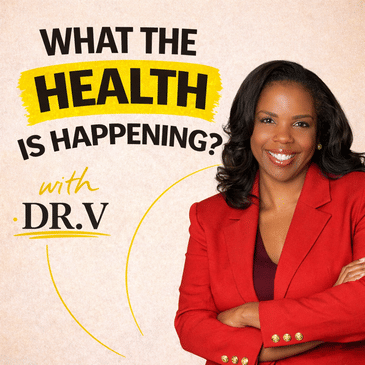
In an era of relentless news cycles, political divisiveness, and constant digital overwhelm, how do we protect our mental health while staying informed and engaged? Join Dr. Valda Crowder (Dr. V), a board-certified emergency medicine physician with 30 years of experience, as she explores the critical topic of psychological safety in today's challenging climate.
This episode tackles the phenomenon psychologists call "chronic ambient stress"—the never-ending background noise of negativity that keeps our stress response systems constantly activated. Dr. V explains what happens to our brains and bodies when we're continuously exposed to troubling headlines, why doomscrolling feels so exhausting, and how "headline stress disorder" impacts our daily lives.
In this episode:
- Understanding the psychology behind our collective anxiety and overwhelm
- Practical strategies to stay informed without burning out
- How to use social media mindfully while protecting your peace
- Managing anxiety about real threats beyond our control (climate change, political instability, economic uncertainty)
- Recognizing and addressing compassion fatigue
- Creating psychological safety for children in uncertain times
- Navigating the suicide crisis and what to do when loved ones are in distress
- Building long-term resilience for sustainable engagement
- The surprising connection between mental and physical health
I'm your host, Dr. Valda Crowder, but you can call me Dr. V. I've been a board certified emergency medicine physician now for several decades, and I've treated patients across four pandemics, one mass shooting and a category four hurricane. So rest assured you are in good hands. Today's topic is a very, very important topic. And basically, I'm going to talk today about how do you create psychological safety during chaos? This is something that literally impacts all of us as we watch the TV and news and we're on social media. And I want to have everyone sort of understand um the psychology but also the physiology behind some of your feelings. What impact does it have on you and your body? What can you actually do to make sure that any negative impacts are mitigated? And how to come up with practical strategies to really protect your mental health and your body without completely disconnecting from reality and while maintaining whatever you feel is your civic responsibility during this time period. Because this question this question is not really about whether or not we should care about what's happening and everything that's going on. It's not about should we care or should we not care. It's more how can we care sustainably and how can we stay informed without being overwhelmed, and how can we create pockets of psychological safety in our lives every single day that will allow us to remain uh resilient, compassionate, and engaged. So in recent months, we've all been bombarded with negative news cycles, divisiveness, economic uncertainty. Um some folks have actually, you know, lost their jobs. We're dealing with an endless stream of troubling headlines. Even worse, we're really seeing like violent videos that are being played repeatedly over and over on a loop. Um for many of us, it simply checking our phones and actually turning on the news can really trigger anxiety and stress or feelings of sort of hopelessness and helplessness. So I want to kind of talk to people about what what is this? And for some folks, this we are living in a psychological state of chronic ambient stress. And chronic ambient stress can occur as a result of really anything. Um it could be a long-term uh health illness of a family member, it could be what's going on now in our society, um, it could be difficulties with children or education or a job can cause chronic ambient stress. And basically, chronic ambient stress is where you know the background noise of negativity and fear and anxiety never actually really turn off. So I want to kind of describe what this looks like. This is this is a live show today, so people can call in at 1-800-450-7876, 1-800-450-7876. So, so let me kind of go over what happens in your body. So, first of all, your body really only has two sets of nervous systems. It either has a parasympathetic nervous system or a sympathetic nervous system. And you're always in one or the other. So let me describe them and then you'll kind of know what I'm talking about. So the sympathetic nervous system is like your fight or flight response. So this is when you're actually, you know, you are in eminent danger. Uh maybe you're uh being um attacked, or maybe you're being discriminated at work. This is where your fight or flight response comes in. And what your body does as a result is it increases its heart rate, it increases his blood pressure, um, you get faster breathing, your muscles tense up. Also, blood flow to your stomach actually turns almost off. So what happens is um you're not digesting food at this point in time, um, your your stomach is not contracting because again, the the goal is to get actual blood flow to your muscles so you can run away and keep yourself safe. Um also what happens is there's a very um unstable or inefficient distribution of blood flow to your brain during the fight and flight response. So now the other system is the parasympathetic system. During the parasympathetic system, think of parasympathetic with a P and think of it as peace, right? So this is when you have peace, uh you're comfortable, um, your heart rate goes down, your blood pressure goes down, you're getting all the signals of safety in your body. Um you get slower and deeper breathing. Um you naturally actually improve your focus and your uh mental clarity. Get very, very efficient blood flow to your brain, and you can get mental clarity without hypervigilance. This is also when um your your body gets more blood flow to the to your GI tract, your stomach and your small intestines and your and large intestines begin to contract and absorb uh absorb the nutrients of the food that you've eaten, and that's the parasympathetic system. So as you can imagine, if the sympathetic system, the one that's fight or flight, is on all the time or on more than it should be, that is chronic ambient stress. And that is associated with, as I said, increased heart rate, increased blood pressure. Um it can even um it can, for some people, it can even cause a heart attack or a stroke. So how do you actually get yourself back into a very calm and have more parasympathetic firing? So I want to actually give people five tips that are really, really important uh for now and and and for what we're actually dealing with right now. So one thing is, you know, it's really important to actually first just even restore your physical orientation. I know I was very stressed during COVID, and I had to remember that today is Monday. And and I had to remember what day it was because I was so stressed that I was actually even forgetting the day of the week. So whether or not it's um remembering, you know, where you are or orienting yourself to where you are, what day it is, what month it is, kind of get your orientation straight. Um, the next thing is, you know, limit how news enters into your body. Should you be watching TVs and videos, um, turn off autoplay and turn off alerts. Um, avoid watching um repeated violent imagery. It's really, really important. I know during 9-11 there was an there was I had problems with the loops of the news where people were jumping off the buildings. Um and I had to really sort of turn that off to really protect myself. And similarly, now I had to actually say, I'm not going to watch the video of Alex Pretti being shot by uh by ice, and I actually did not watch the video. So so for some people actually not watching that violent imagery is really, really important. Um, the other thing is, you know, what is actually required of you right now? What can you actually do right now to impact or affect this particular situation? And a lot of times the answer may be nothing, right? Um there's nothing that I can do to impact the situation. So I actually need to impact my own body and my own situation. So what do I need to do if I'm not gonna act? I have to be able to sort of tell my body to actually go into that parasympathetic mode, that peaceful mode, and get out of the fight and flight. For some people, that's kind of remembering when they were in a peaceful mode before, what makes them feel peaceful, or doing something that makes them feel peaceful. Whether or not it's going for a walk, going for a swim, whatever it may happen to be. I know for myself I enjoy a hot tub or a hot bath. So, whatever it is, you kind of have to move yourself gently past that exposure. And also create an ending, close the loop, because for some people this goes on and on and on and on. And so you want to really close the loop, whether or not that's putting the phone down or shifting to something else that you need to be doing. Research has really showed that constant exposure to negative information really activates the sympathetic or the fight or flight, leading to what people call headline stress disorder. They also call it doom scrolling fatigue. Our brains really evolved to respond to immediate physical threats. And now what's happening is that system in our body is being constantly bombarded and used for things that are actually not immediate threat, but instead are really kind of distant dangers. This really creates it creates like a perfect storm for anxiety, depression, exhaustion, etc. Um, what the health is happening, that's a real question, and it's the name of my new podcast where you can literally get life-changing advice. What the health is happening is where we give you the inside scoop on health matters and empower you with information, everything from breaking news to all medical updates. What the health is happening is your dose of medical reality with me, Dr. V, and my friends on the front lines of healthcare. You can actually download, subscribe, and comment on all podcast platforms. All right, we've got two callers here. Um let's take Dr. Myers first. Uh go ahead, Dr. Myers.
SPEAKER_01Yes, hello, Dr. V, and thank you so much for your presentation on the need for peace and the need for calm. Uh, the organization I represent, Black Women for Positive Change, we want to start a national movement where people begin to realize peace is a conscious decision. Yes, it is. You know, you can you can fight, you can scream, you can cuss, you can holler, or you can love and be peaceful and try to get along. And we know the culture of violence in this country goes so deep. So we so we're really trying to promote a peace pledge initiative. And so we appreciate what you're doing. Do you my question to you is do you think people can bring about peace in their families and their neighborhoods if they really try?
SPEAKER_02You know, it's funny because some people actually equate peace with giving up what they want. Like they think that, well, if I create pe in my the only way I can create peace is to give up what I want. Right? And I I think that what happens is there's a lot of ways to actually resolve conflict peacefully, right? So I can still advocate for myself without actually I can advocate for myself in a very peaceful way. I always tell my I tell people, you know, my mother's from the from the deep south, she'll curse you out very peacefully. You'll you'll kind of leave the situation and be like, and she won't even use a curse word, and you'll be like, I I think she just said what? Like And so I think that people should really practice conversations and maybe even with friends, if they're dealing with conflict, and actually really kind of learn how to advocate for what you want without demonizing the other person and do it very peacefully with civility.
SPEAKER_01Absolutely. And we're trying to encourage people to take a peace pledge so that they can really focus on that. Because when you have conflict, you have to pay lawyers fees and court fees, and it can be very expensive to fight.
SPEAKER_02It can cost you your life to fight. It can so where would people actually get the peace pledge and or or do you have it? Can you can you can you say it now?
SPEAKER_01Uh sure, I'd be glad to say it. It's the nonviolence peace pledge. I pledge to uphold peace in the name of nonviolence and to work to keep my brothers and sisters safe. I promise to seek the path of peace and to treat others with fairness and respect. I pledge to do this for the sake of humanity so we can all live together in peace and harmony. And we're asking your wonderful audience, uh, what the hell health is happening audience, to go to Blackwomen for PositiveChange dot org. They can read the peace pledge there and make a videotape of themselves chanting it and send it to us.
SPEAKER_02Oh, great. That's that's great. Thank you for that. I appreciate that.
SPEAKER_01Thank you. Thank you, Dr. V for all you do. Thank you.
SPEAKER_02Thank you. All right, we've got another call here on uh line line two, Kimberly. Good morning, Dr. Valda. Hi, how are you? I'm doing fantastic. Happy Monday. Yes, and we call it Medical Monday here on the Dr. V show. That way I had to remind people that it's every Monday where we're talking about everything that's important healthcare.
SPEAKER_00Well, I'm so excited to be on your show. Thank you so much. Uh, just wanted to talk to you a little bit about uh my program. It's called Vibe Checkup, the power of checking in. It is a youth mental health digital platform that is a three-way ecosystem that provides uh care and support for youth parents and teachers. And what I'm experiencing with my kids is that they are experiencing what their parents are experiencing in these crazy times, and they're having a hard time with being able to express themselves because they can't really talk to their parents about it because their parents think that they're too young or that they don't understand their high school students. Oh, yes. And and it really is impacting them because they are black and brown children who are seeing, you know, their friends and families, you know, maybe not necessarily getting arrested, but they're not going to work, they're not going to school because of the fear of being um, you know, deported or picked up. Yes, yes, yes, and deported, yes. Right. And so it's become such a strain on our kids, and we do a podcast called Real Talk Food for Thought that allows them to express themselves. And so, you know, I'm calling you because I just want the um your viewers just to, if they have, you know, children that are even in junior high school to start having these meaningful conversations with their kids about what's really going on.
SPEAKER_02So so so let me so let me actually let me so let me ask you let me ask you this because a lot of people and I agree with you completely that most people don't realize I I tell people kids as young as six, seven, eight years old know what's going on, right? And to treat them like a child and not have a conversation with them like you can have a a it and a conversation that's pe that's appropriate for their age, but don't assume that they don't know what's going on because their little minds are running and um they are creating um their own uh conversation about why this is occurring, what should be happening, what should not be happening. A lot of parents don't know how to actually start the conversation and how to actually begin to have a conversation with their kids about uh about what's happening. Do you have any recommendations for our audience about how to actually start the conversation?
SPEAKER_00I I really do. We actually have an app that just dropped. Um we we're we're actually launching in a month, but that that app is gonna allow um parents to get the right um language to use when they are trying to address their when they're trying to to talk to their kids. Um and also gives the the children you know the exact same type of communication skills in order to even bring it up so that you know the parents understand um that the kids are actually having a hard time and and what that does is it really puts everybody on the same page in terms of communicating with one another.
SPEAKER_02So so so if if I were talking to a young person or if you were talking to a young person right now, what would you say? Just give me one or two sentences of what what what would you say to actually bring up the conversation? Because a lot of times what happens is we're not really in a conversation with children about the news, right? People talk to the kids about maybe, you know, what's gonna be for dinner, are you gonna be able to go over to your friend's house? Are you gonna be able to go to the movies? Do you know what I mean? I mean, would you say, you know, hey, I I hey, I just want to talk to you about what's going on in the news. Do you start it literally that blatantly? Um, do you say, you know, I'm having some concern or are you having any concerns? Because usually if you say, Are you having any concerns or are you okay, they're gonna say I'm fine. Like that's you know, I know I know what the young kids say in my family, they're all they're always fine until they're not.
SPEAKER_00Right. Until they're not. Right. So what I do, uh what I do say to parents is put it on eye. You know what? I just want to let you know I'm feeling some kind of way about what's going on. And you know, we have family that are immigrants, and I'm getting kind of worried, you know, and you know, see if something is gonna happen to them. So are you feeling the same way? Have you had those kind of same feelings? I would bring the parent, the parents bring up the conversation in terms of its impacting them.
SPEAKER_02Gotcha. Okay, so you you recommend they start the conversation about here's how I'm feeling, therefore, how are you feeling? Well, thank you so much for that contribution to this conversation.
SPEAKER_00Well, thank you so much. I really appreciate it, and continue all your wonderful work. Really love the work that you're doing in the community.
SPEAKER_02All righty, thank you. All righty. I want to actually um take a couple of take a question or two that I've actually gotten uh from online. Um, one of the questions I got in is from Monica. It says, What are some concrete and daily practices I can implement to create personal safety in my home and my personal life when the outside world feels so unsafe? Um, this is really important. I think, you know, everyone has different daily practices, but I know a lot of people who really try to spend, you know, 15 or 30 minutes with themselves in the morning, grounding themselves. Now, some people pray, some people chant, um, some people literally sit on the ground or put their feet on the ground, um, some people meditate, um, some people stretch, some people exercise. You want to create some sort of a spirit, some sort of a practice that actually allows you to kind of get yourself grounded. I think once you actually get grounded, I think the other thing that is really important is you can really anticipate the things that are gonna actually cause stress during the day. I know I can. And so I kind of know the person that I'm gonna have a conversation with and it's gonna be difficult, the situation that I'm going to have to deal with that's going to be difficult. And I really try to prepare for the various ways that I'm going to actually address the situation. Um, what are the possible outcomes? What am I gonna do? What am I gonna say? How am I going to stay calm when they are actually coming at me? They may be attacking at me. Um, I know for myself specifically, every time I go work in the emergency department, I sit in the hot tub for about 30 minutes before I go to work. It calms me down. I go into work and I stay calm, and I need to stay calm while everyone else is actually really, really, really hyped. Um, the other thing that is important as a daily practice is to wind down before you go to sleep. Sometimes people turn off the TV an hour before they go to bed. Some people uh get a glass of of warm milk. Some people drink a glass of wine, although wine is has has been known to actually uh make you less likely to have REM sleep or you have less REM sleep as a result of drinking wine. So for some people it calms them down, but physiologically it doesn't quite it doesn't quite work. So you've got to kind of practice with some of these various things and sort of find the thing that actually uh works for you. So here is uh another question that we've got, and this uh question uh came from Sheila, and it says, uh she says, I find myself constantly worrying about the future, climate change, political instability, economic uncertainty. How do I cope with anxiety about things that are real threats, but that I cannot personally control? So this is really important. It is really, really important to distinguish between what you have personal control over and what you do not have personal control over. There are some things that are causing a stress that you absolutely have personal control over. If you need to actually find a better job, uh sending out resumes, or you need to get, you know, your car is going out, you need to get a new car. There are things that are stressors that you absolutely have control over, and then there are things that you don't have control over, and a lot of the stuff falls into the category of what we don't have control over. And those things that you don't have control over, I think is Really important to look at how I can actually organize with people that are like-minded. Find organizations and community groups that are like-minded. They may be pushing uh legislation in your state or or federal legislation. They also may be doing voter registration or supporting certain candidates that support your initiatives. So you don't have direct control over these things, but you can actually organize with people that similarly support whatever initiative you are supporting. And I think that is really, really important. Alrighty. I want to thank you guys today. This was a really, I think this was a really important show for the things that we have going on. Please don't forget to download the podcast, What the Health Is Happening, and listen to that. It is on all streaming platforms. Psychological safety is not about ignoring problems. Instead, it's about ensuring that you have the inner resources to show up for yourself, your family, and your community.