
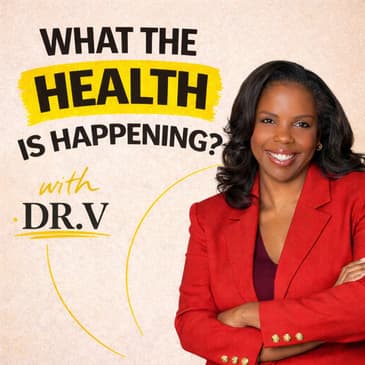
Welcome to "What the Health Is Happening?", the podcast where Dr. Valda Crowder, also known as Dr. V, is committed to empowering you with life-saving information. Dr. V is a board-certified emergency medicine physician with decades of frontline experience. In today’s episode, we’re diving deep into a silent epidemic quietly eroding the health of millions: chronic stress.
We’ll explore how chronic stress is fundamentally different from the everyday pressures we all face, unpack its widespread impact on our bodies, from raised cortisol levels and immune suppression to heart disease and mental health struggles, and discuss why it so often goes unnoticed in our daily lives. Dr. V will tackle tough listener questions about stress in our communities, culturally grounded coping mechanisms, the unique burdens faced by women and minorities, and even what policymakers can do at the national level.
If you or someone you know has ever felt overwhelmed, exhausted, or simply accustomed to "just getting by," this episode is for you. Get ready to learn, reflect, and discover strategies to reclaim your health right here on "What the Health Is Happening?".
Timestamps:
00:00 Understanding chronic stress
04:21 Chronic stress impacts on health
08:57 Managing stress and physical health
12:07 Chronic stress and faith communities
15:13 Impact of stress on aging
19:23 Workplace stress and support systems
20:29 Improving youth mental health programs
26:06 Navigating burnout and chronic stress
27:07 Supporting future medical scholars
Dr. Valda Crowder - https://www.askdrv.us/
Podcast Website - https://whatthehealthishappeningshow.com/
Podcast Producer - https://tophealth.care/
“Disclaimer: Informational only. Not medical advice. Consult your doctor for guidance.”
Hello, I'm your host, Dr. Valda Crowder, also known as Dr. V, and I've been a board-certified emergency medicine physician now for many decades, and I'm committed to empowering you with life-saving health information. Do me a favor today, we're gonna actually have a show today. We're gonna talk about chronic stress, but it's also important that you actually subscribe to the podcast, What the Health Is Happening. It can be found on all streaming platforms, and you can also follow me on all social media outlets. We work very hard every week to bring you and prepare for you accurate evidence-based information on your most pressing healthcare questions. It is never more needed than now when there's so much fake and misleading and confusing information on the internet and airways. So please make sure to download, subscribe, and comment on my podcast, What the Health Is Happening. All right, today we're going to take a deep dive into something that is quietly destroying the health of Americans across the country, and that is chronic stress. So chronic stress is very different from normal stress that we experience in our lives. So you may have stress related to an upcoming deadline, or you may have stress related to running late for a meeting or a traffic jam that may be occurring. But that's very different from chronic stress. When you have normal stress that we have with life, that is stress that sort of turns on related to the deadline or getting to a meeting on time, and then it turns off, and your body goes back to its normal homeostasis or its normal equilibrium. What I'm actually talking about is chronic stress. And chronic stress is where you become stressed and it stays on for months and years. Alright, so this sort of stress really doesn't turn off. And it can be in the background, you can notice it, and sometimes you can actually really get used to it. And it is related to a lot of different things. Some people have chronic stress because they have chronic financial hardships. Some people have chronic stress related to generational trauma. Other people have uh chronic stress related to systematic racism or discrimination, or maybe their community is in some way, shape, or form under attack uh chronically. So this is a conversation that I really, really wanted to have because literally our lives really depend upon what we do and how we handle uh chronic stress. So, first I want to talk about what happens when your body is chronically stressed. So, one of the first things that happens is your cortisol levels increase in your body. So, let's talk about what is cortisol. Cortisol is a steroid hormone, and it is a steroid hormone that your body naturally produces, is actually produced in your adrenal glands. And your adrenal glands actually sit on top of your kidneys. And cortisol is what we often call your stress hormone. It helps your body respond to stress and actually regulate really important functions. But cortisol is meant to turn on and then turn off. So when you have cortisol floating around in your body and it never actually can turn off, it can affect a lot of different organs. So when it comes to sort of your brain and your mental health, high cortisol level chronically can actually cause anxiety, depression, irritability, memory problems, difficulty concentrating, and also can cause problems with sleeping. It also impacts your immune system. So you'll find that you get more infections. Maybe your infections are slower to heal. You'll find a lot of things associated with immune system suppression. The other thing that happens when you have chronic stress and high cortisol levels is that you'll find that there are metabolic effects. So your body will not respond to the insulin that it produces. You'll find that you'll get gain more weight, particularly around your waist. Some people are more likely to get then diabetes type 2 or to be labeled as borderline diabetic. Also, we find that it has an impact on your blood vessels and also on your heart. So it can elevate your blood pressure, it increases your heart rate, and you wind up being more at risk for heart disease and for strokes. For women, they may find that there are sort of hormonal disruptions that they will also notice. So they may have fertility problems, they may have problems with their menstrual periods, and that is what sometimes women will actually see or see as an impact. Also, in general, as you as you find that cortisol levels are increased in your body, um, you will also find things like muscle loss, increased risk for osteoporosis, which is a thinning of your bones. So all of these things sort of occur, and it's really, really important to actually figure out a way how to actually repair your body and get your body out of a chronic stress situation. So if you can relate to some of these issues and some of these problems, you you may need to take a look and see, you know, do I have chronic stress running in the background of my life that maybe I've uh gotten used to? So I really want to hear from you so we can learn from one another. So please give me a call and ask and ask any questions that you have. I can be reached at 1-800-450-7876. That's 1-800-450-7876. And as always, you can email me at info at asdrv.us. That's info at asdrv.us. What the health is happening, that is a real question. It is also the name of my podcast, where you can literally get life-changing advice. What the health is happening is where I give you the inside scoop on healthcare matters and empower you with information on everything from breaking news to health and medical updates. What the health is happening is your dose of medical reality with me, Dr. V, and my friends from the front line of healthcare. It can be heard on all podcast platforms. Please download, subscribe, and comment. All right, we've got a couple questions here from some listeners that were emailed in, and I want to uh kind of go over them and get them answered. All right, we've got a question from James. So James says, Dr. V, when we talk about stress or chronic stress in our community, why do you think we often dismiss it as just life rather than focus on it as a serious health threat? This is a really, a really good question, James. So people often adopt to chronic stress without really um realizing it. And it's really because your body sort of resets what is normal. So what happens is when you are stressed out over and over and over again, your body, through something called the hypothalamus pituitary adrenal axis, stays activated long enough that you actually become accustomed to functioning at a higher level of stress. And some people will say they feel fine, but they don't actually realize that their body has sort of acclimated or adjusted to this higher level of stress. That doesn't mean that all of these things are not still going on in your body. So you're still having elevated blood pressure, an elevated heart rate, insulin resistance, even though you actually may feel fine. So this is actually what happens over time. It's what we call, we call it in medicine, we call it stress habituation. And so, and basically because stress becomes a habit for you, it becomes your new normal without even realizing it. How to get people to actually recognize that I'm in a chronic stress state and that now feels normal for me. So here are some things that sometimes help you realize that you've been chronically stressed. For some people, they go on vacation. So if they go on vacation for a week and they actually experience sleeping better, their body sort of resets, it makes them actually acknowledge or realize how much stress they have been under. The other thing that's really important is sometimes it's family or friends that say, you know, gosh, you seem exhausted, or you know, every time I talk to you, you're on the edge. You never relax. Um it may be family and friends that actually uh bring you an awareness. And for some people, they actually notice that their blood pressure is higher, or they go to their doctors and their medications are being adjusted and their dosages on their medications are being increased, or additional blood pressure medications are being added to them. They may have sleep trackers and realize, wow, I'm I'm not sleeping very well. And in some situations, some people just get their cortisol level checked. It is a blood test that you can get ordered and you can ask your primary care doctor to order it for you. You can get your baseline cortisol uh level. Usually it's best to uh check it in the morning. And so, you know, if you're gonna do that, you want to make sure that you talk with your physician and you get the best timing on that, but you can get your baseline cortisol level um checked in your blood, and that'll also tell you, and that is also something you can monitor over time. So, James, this is something that people actually get acclimated to and they feel like it's kind of like their normal way of doing life. Um, and it is really important that you reflect on your life every once in a while and take a look at am I handling too much? Uh am I uh am I gaining weight? Am I sleeping well? Is my blood pressure going up? I may be doing all the things and accomplishing all the things that I want to accomplish, but at what expense to my body? And how do I create a life where I can still accomplish those things, but it not be to the detriment of my physical health? So great question, James. All right, Stephanie's got a question that she emailed in and she wanted to know what are some uh coping strategies for dealing with uh chronic stress and what are some things that uh we can do that would actually make a difference. There are uh a lot of things that can be done around this. One of the main things is to get about 30 or 45 minutes of some sort of physical activity a day, whether or not it's yoga, walking, swimming, cycling, and it doesn't have to be strenuous. A lot of people, you know, kind of see exercises. I'm gonna go into the gym and I'm gonna really pound it. It can just be a leisurely walk outside. This doesn't need to be anything that's particularly strenuous. Um, the other thing that actually really makes a difference is improving the quality of your sleep. I've done another podcast on sleep, which I would uh remind people to actually take a take a look at. But a couple of things really make a difference as far as sleep is concerned. One is try to go to bed at the same time every single night. Um, also try to reduce your screen time before you go to bed, and definitely do not bring your cell phone to bed or on your nightstand or look at it at night. That definitely actually decreases the quality of your sleep. You really want to be in a dark, cool room, um, and you really want to make sure that you get seven to nine hours of sleep. That absolutely makes it makes a difference. Um, the other thing is strong social support. Um, really having friends that you trust that you can talk to, uh, spending time with your family, uh, any sort of social support that is actually positive, a positive contribution to your life, that is also really important. The last thing I would say is nutrition really makes a difference. Um, you really want to try to eat balanced meals that are high in protein and fiber, and you want to really reduce your caffeine intake and your sugar intake. Those are the things that will sort of additionally ramp up your system. So these are some of the basic things that can kind of be done to slow or decrease chronic stress, and I think it's really, really important. All right, Rebecca has a question, and she said the church has historically been a center a central pillar of many minority communities. How can faith communities do more to address chronic stress and its health consequences? I would also like to know about culturally grounded coping strategies. There are a lot of things related to faith and faith-based that can kind of make a difference in uh chronic stress. So some people actually really rely on prayer circles or chanting or meditating daily. It's also really important uh things around um journaling or gratitude practices that people may have in a in a church environment. Um, it would also be very important to even just have this conversation so that people can actually take a look and reflect on their lives and have a community where they feel safe to have some of the conversations about what is actually going on in their lives and what they actually are trying to resolve in their lives and and to just even getting support around just being heard and being encouraged are very, very important when you talk about chronic stress. I often tell people chronic stress is not necessarily about a particular chronic problem being resolved. Sometimes it's actually dealing with that particular chronic problem, but feeling like you can talk about it in your in your social circles or in your church or fellowship uh circles and actually be heard as far as what you have going on in your life. So, yes, the the the church and faith-based communities are very, very important. And I would encourage people to actually bring up the issue of chronic stress and the impact of that on their health in those environments. Brittany has a question. She says, Dr. V, women carry extraordinary burdens as far as caregiving and professional pressure and societal expectations. How does a strong woman archetype contribute to untreated chronic stress? So this is really this is really uh important because I think that a lot of times um women are carrying a lot of different hats and jobs as far as at home and at work. I know for women physicians, we actually have a lower life expectancy than our male physicians, um, and it is related to this additional burden that we have between our job and our homes. So I think I think this is this is this is very important. A lot of times women feel that if they don't do it, it won't get done, or if they don't do it, it won't get done right. Um, or I should be able to handle this myself and not ask for help. And it's really important to actually learn the skill of delegating. And sometimes what we have to do is we have to start first with low risk requests. And this is what I would call is you know just asking for something small. Maybe it's asking for a colleague for input, maybe it's letting a friend help with a task, maybe it's sharing responsibility on something in the home or at work. And these sorts of small requests, when they're successful, they actually tell you, oh, okay, I can delegate. It kind of provides a feedback loop to your brain, and then you can actually go and grow and actually then request larger things. All right, Vicky asked a question. Dr. Arlene Geronimos coined the term weathering to describe how racism ages black bodies faster. How does this concept resonate with what you've seen in the emergency room or with your own family or community? So the term weathering really describes, again, long-term exposure to chronic stress. Um, and again, it can be related to racism or sex discrimination. It can also be related to financial hardship. And it does gradually wear the body down and accelerates uh biological aging. Um so it's it's very interesting. I see this a lot in the emergency department. Um you will see someone who is 60 years old and may look like they're 80, and then you'll see someone who's 60 years old and maybe looks like they're 40. So um we always say in the emergency department, it's not the years, it's the miles, kind of in reference, tongue-in-cheek, to a car. Um, you know, you can have a new car with a lot of miles, or you can have a new car that doesn't have a lot of miles. I think that um it is not only chronic stress, but it's also all the things that also come with it. So if you have chronic stress related to financial hardship or discrimination or generational trauma or whatever it may happen to be, and then you put on top of it that you smoke, or you put on top of it that you do drugs, or you put on top of it that you chronically abuse alcohol. There's all of these things that layer on top of chronic stress. And so, and it has a multiplicative effect, right? And so, usually what we see in the emergency department and in, you know, and in my in my life and my family, we just we see the multiplicative effect of how you've been living your life. And so, and that can actually be reversed. Um, and so a lot of people who have have noticed this, like and I give a great example. A lot of people have noticed this who've actually even just quit smoking for 10 or 20 years. They're like, wow, I didn't know that I could breathe so much easier. Um, or it slows down the aging process, it slows down wrinkling, or you know, um, they're less likely if they're men to become impotent. Um and so, yeah, we see this in a lot of I see this in a lot of different settings, but it's not just chronic stress. It's chronic stress coupled with many lifestyle elements that actually lead to um weathering, and it's literally weathering like weathering of an old shoe. Um and so yeah, I I think uh it is something to really be mindful of. All right, we've got another question here from Rachel. Hey, Dr. V, how do we create a culture shift in our community where we can actually ask for support when we're stressed or actually seek mental health support and not have all of this stigmatized as a weakness? This is a really great question, and I think this is really important because this is something that all of us can do. So, first of all, start with open conversations. I consider this show and picking this topic to be uh an opening conversation. It's really important for people to share when they have felt stressed or burned out or if they're currently feeling stressed or burned out. It really helps for other people to realize that they're not the only ones. And I think that, you know, if you have actually sought counseling or support, talk about it. Uh, don't hide it. It is really important for people to realize, like, okay, well, how many times did you go? What difference did it make? How much did it cost? You might be surprised at what some of the people may actually uh in your life may uh may learn from your own experience. It's really, really important to really connect um your spiritual life and your mental health and your physical health well-being. Um, a lot of people see mental health as sort of separate, but your mind and your body are totally connected. And so I think that um just talking about, you know, you might talk about your physical health, but you might not want to talk about your mental health. At the end of the day, it's your entire health picture. Um, it's also important when you go to your physician, when they say, hey, is anything bothering you? Are you having any problems? You know, sometimes people say, Well, you know, gosh, if I've been anxious recently, I'm not going to tell the doctor about that. He doesn't care. No, they do care because they realize that again, your body and your mind are totally connected. And so share what's going on with yourself mentally as well as physically with the providers. I also say create a lot of spaces for listening, whether or not it's small group discussions or family check-ins or support groups or pastoral pastoral counseling, all of these things are really, really important. Um, many people just don't realize how much chronic stress really, really impacts their body. Lastly, a lot of people are dealing with chronic stress at their jobs. And I just want to take a minute to actually really talk about that. Um, it's really important. Some jobs are actually set up to actually create stressful environments, and other jobs are focused on employee well-being, and they have support structures for employee well-being. So you want to look at what resources does your job have that would help you actually deal with burnout or stress? It's also important to look at, you know, your managers and your leaders, and if you are a manager, how do they discuss stress management? Do they openly talk about counseling or coaching? Do they encourage you to take vacations and time off? Um, are they okay when you create boundaries? What is the psychological safety network at your job? Is it okay to ask for help? Is it okay to admit mistakes? Is it okay to just to discuss something that is stressing you out? It's really important to really look at the environment that you actually work in. For some people, their job is a major, major component of their chronic stress. And they either need to alter that environment by saying no and creating boundaries, and in some situations, they actually may need to change jobs. Thanks for that question. Hey Dr. V, if you could tell policymakers or people in the government about the connection between chronic stress and their health and provide recommendations on what they could do, um, what would you tell them to do? This is a really this is a really great question because this is actually what we call uh getting into things called population health. So population health is where you actually begin to make a difference and actually transform the health of a population rather than an individual person at a time, which is how most people actually interface with the healthcare system. So the first thing I would actually, the first thing I would actually really talk about, and the things that would actually really be important is to improve school-based mental health programs. It is really, really important that you start young, where kids realize the importance of actually being able to talk about the things that are stressing them, whether or not it be in a peer-to-peer setting or with a counselor, and where, you know, you have social emotional learning programs where people learn how to actually delegate and say I need help, how to admit that I've made a mistake, how to actually get the help that I need. Um it's really, really inf important that we provide a lot of these tools to our kids so that they can then grow up as healthy adults that actually have the tools to manage some of life's ups and downs. I think we're really finding that our our young people are coming out very ill prepared uh for managing a lot of life's ups and downs, and it's leading to an escalation in um depression and anxiety. Sleep problems. So I would one specifically ask for school-based mental health programs that are across all K through 12. The other thing that I think would be important is integrate mental health and primary care. I think that right now you go to your primary care doctor, and if you want to go see the counselor, that is somewhere different. I I think it would be important to give uh bonuses or uh increased reimbursements for primary care facilities that embed mental health services in the primary care services so that that way when you go see your doctor for your annual checkup, um you can just go get everything done all at one site. I think that makes it more likely that people actually will actually take care of both their physical and their mental health. And the other thing I think would be really important is is to really look at workplace stress. Um we right now, you know, it would be really important. We've got we've had like FMLA and certain things that make it easier for you to actually have family leave, but I think paid sick time and family leave and a certain baseline foundational criteria that is across the country so that everyone knows you at a minimum you have these amounts. Um I also think that it's important to have um workplace mental health protections and workplace mental health resources. For some people, um, that is a place where they will actually begin to reach out and get uh get additional help. I am actually encouraged by a lot of the mental health resources that are occurring online. It's making it easier for people to reach out and get help on their phones, talk to talk to providers on their phones. I think that's a really important. The last thing that I would say that is critical is that we increase the number of psychiatrists and psychologists uh in the United States. We currently have a shortage of psychiatrists and psychologist uh scholarships and loan programs that encourage people to go into the mental health field. All right, I've got a question here and it's from Bradley, and he wants to know he's seeing people at his workplace that say they're burned out. What exactly does that mean and what does that look like at work? So, uh Bradley, great question. You know, what happens when people are burned out is is really that is chronic stress that has been so severe and has occurred over such a long period of time that has actually um changed almost your personality. It's almost changed the way you interface at work, and it can show up a lot of different ways for a lot of different people. So as an example, uh some people can show up and basically have an attitude of, I hate this job, I don't care about this job, uh, I hate these people, I don't care about these people. Some people kind of come and they're they they kind of have that sort of attitude. Um, you'll also see some folks who kind of show up to work and they just chronically look tired. Um they look like they got out of bed to come to work, but they still really want to be in bed. Um and they're like, Yeah, I'm here. What do you want? What's next? Almost like they're just buying time. Um, you'll find that some people um will feel um very ineffective. Um, they will feel like they're not really making a difference at the job, and um some will, some other folks will just feel a sense of hopelessness. So it's a it's a very, very severe form of chronic stress. Um, for some people, they actually need to take some time away from the job. They may need to take uh a vacation. For some people, they may need to actually take several weeks of vacation. Um, other people actually find that they actually need to change their career. Um, maybe they thought that this career was going to be something and it turned out to be something different once they actually got in it. For some people, they've actually advanced as far as they can advance, and there's there's nothing more to attain, so they kind of lose interest and uh it just sort of feels like a routine monotony. Uh I'm just going in to um do the hours and make the money and go home and that's it. And so that is what burnout is, and it can occur really in any profession. Um, I know that we have, you know, some we we talk about burnout a lot in the medical profession. Um, and some people retire early as a result of it. They feel like they don't really want to change careers and they just retire early, and that is an option. Um, if you don't necessarily want to uh change careers and you've saved up enough money to retire, some people just retire. So that is what sort of burnout looks like. But I think it's really important that if you're experiencing burnout, that you actually see that as a mental health crisis and that you actually look at, you know, getting some counseling or getting some help and actually navigating your way through that burnout so you can get on the other side and create a life that is a lot more fulfilling uh for you and your family. So I want to thank you guys for having this conversation with me today about chronic stress because it is really something we all know, someone who is in our family or our community or our coworker that has been or is currently impacted by chronic stress. And it is really important that we have the conversation about how to sort of navigate that and how to get to a more peaceful place in your life and a healthier place. The mission of the Channel of Health is to inform, educate, and empower communities about pressing health care issues. The Channel of Health also provides scholarships for MCAT Prep and school scholarships for promising scholars majoring in science and medical-related careers. You can support our efforts to educate and empower our communities. Go to askdrv.us, askdrv.us, or channelofhealth.org. I want to thank you guys for joining me today. Um, this has been a really great show. Um, we're really committed to answering um all of your most pressing questions. Make sure to email me or send me an audio message at infotasdrv.us. That's info ataskdrv.us. You can also follow me on YouTube, Twitter, uh at askdrv. And please make sure to actually download and subscribe to my podcast, What the Health Is Happening, on all podcast platforms.

